
Equipment Hauling 101: Moving Skid Steers, Forklifts and Machinery
To move a skid steer, forklift, tractor, or other machine, call an equipment hauling service and provide the machine's exact weight, dimensions, condition, and loading situation. Local towing companies with landoll, lowboy, or step-deck equipment can often handle short moves more directly than a freight broker.
The price is usually hourly, flat-rate, or a base charge plus mileage. The right quote depends less on what the machine is called than on whether it fits, can be loaded safely, and can travel legally.
Choose the trailer by the job
Equipment trailers solve different loading and clearance problems. You do not need to become a trailer expert, but knowing the basic types makes a dispatch conversation easier.
Landoll or traveling-axle trailer
A landoll-style trailer tilts and lowers its deck, allowing equipment to be winched or driven aboard at a relatively gentle angle. It is useful for forklifts, containers, disabled machinery, and equipment with limited ground clearance. A winch can load a machine that does not run, provided its wheels or tracks can move and the pull can be rigged safely.
Lowboy trailer
A lowboy has a low deck that helps tall or heavy equipment stay within legal height. It is common for excavators, larger loaders, and construction machinery. Loading may be from a detachable front or ramps, depending on the trailer.
Step-deck trailer
A step deck has a higher front section and a lower main deck. It can carry equipment that is too tall for a standard flatbed while offering a long usable deck. It is better suited to planned transport than tight recovery work.
Flatbed or rollback
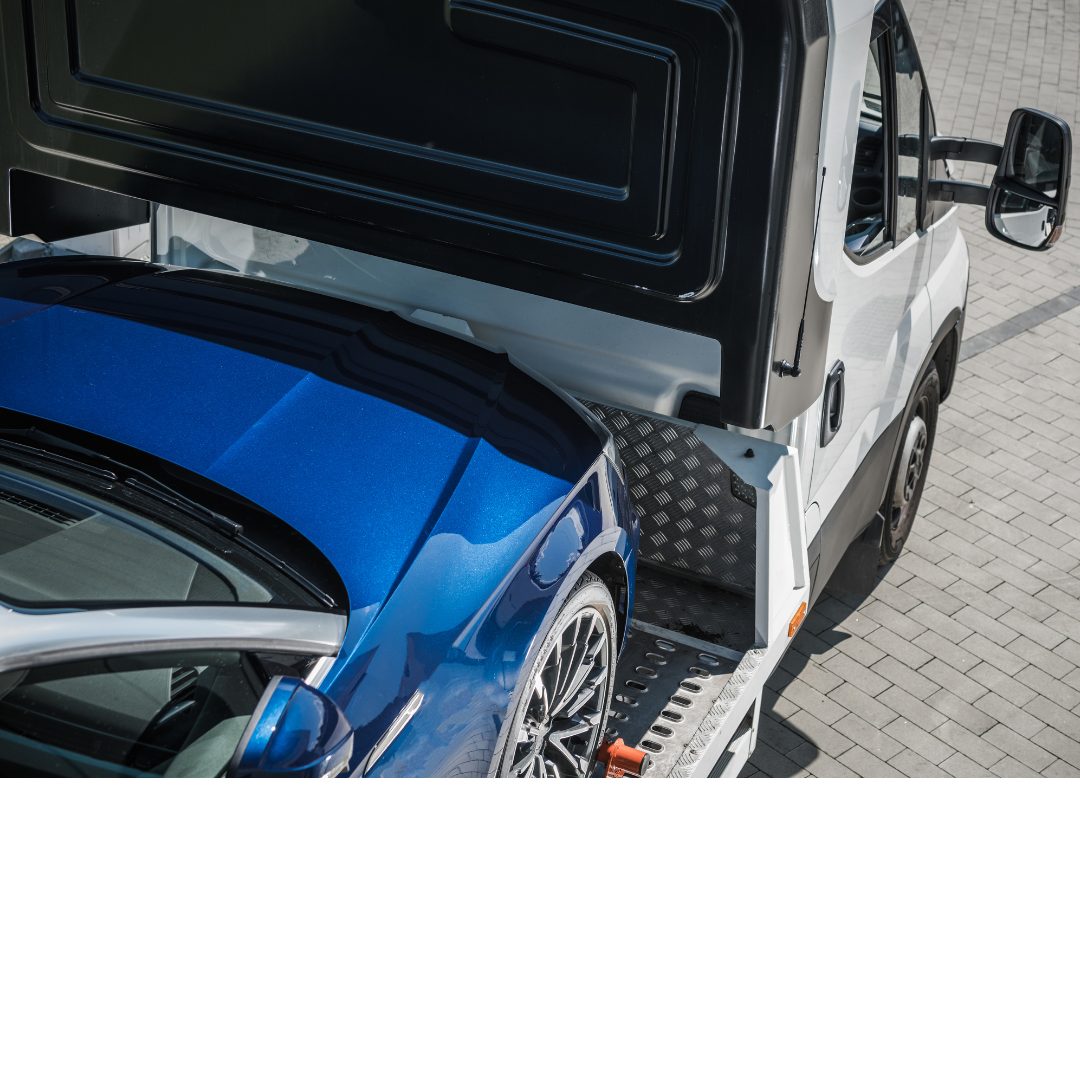
A heavy-duty rollback can handle smaller machinery for local moves, if the weight, width, and loading angle are within its ratings. A compact skid steer may fit; a large forklift with a tall mast or concentrated axle weight may not. The provider must decide from specifications, not a guess.
Information the hauler needs
Find the identification plate, manual, or manufacturer specifications. Then provide:
- Make, model, and equipment type.
- Operating weight, including attachments, fuel, battery, or counterweights.
- Overall length, width, and height in transport position.
- Wheelbase or track length and ground clearance.
- Whether it runs, steers, brakes, and rolls freely.
- Attachment details, such as forks, bucket, backhoe, or boom.
- Pickup and delivery addresses with access notes.
- Surface conditions: pavement, gravel, mud, grade, or indoor floor.
- Available loading dock, ramp, or on-site loader.
- Fixed obstacles such as gates, wires, branches, low doors, and tight turns.
Photos are valuable. Include the whole machine, each side, tires or tracks, attachment, loading route, and any damage. If the equipment does not run, say whether the brakes are released and whether the steering can be moved.
Do not use an empty or shipping weight when the machine carries a heavy attachment. The hauler needs the actual transport configuration.
How pricing usually works
Local equipment hauling may be quoted as:
| Pricing method | Common use | Check before booking |
|---|---|---|
| Hourly | Local work with uncertain loading time | Minimum hours and when the clock starts |
| Flat rate | Simple move with known access | Included loading, mileage, and unloading |
| Base plus mileage | Longer predictable route | Billable deadhead, tolls, and fuel charges |
| Project rate | Oversize or difficult recovery | Permits, escorts, rigging, and extra trucks |
Loading difficulty can matter more than distance. A 10-mile move from a muddy construction site may cost more than a 40-mile dock-to-dock move. A disabled forklift with locked drive wheels may require skates, rigging, or another machine to help load it.
Ask for an itemized written quote. Confirm waiting-time charges, cancellation terms, permit costs, after-hours rates, and responsibility for site damage. The towing cost calculator can help with a road-mile baseline, but machinery transport requires a capacity and access review.
Permits and legal dimensions
Equipment that exceeds ordinary legal width, height, length, or weight may require permits, route restrictions, signs, or escort vehicles. Exact limits and procedures vary by state, and local roads can add separate restrictions.
The carrier should determine whether the loaded combination needs a permit and who obtains it. Do not assume that a short trip across town is exempt. A low bridge, posted road, school-hour restriction, or construction closure can change the route.
Our state towing law guides are a useful starting point for state-specific contacts and rules. For a permitted load, ask the carrier to confirm the approved route and timing in writing.
Loading a skid steer
A skid steer is compact but dense. Give the operating weight with the bucket, forks, or other attachment installed. Lower the attachment for transport, follow the manufacturer's securement points, and make sure loose tools and debris are removed.
If it runs, only a trained operator should load it. The trailer must be stable, correctly positioned, and rated for the machine. If it does not run, the hauler may winch it, but track or hydraulic conditions can complicate movement.
Loading a forklift
Forklifts have concentrated weight and a high center of gravity. The counterweight makes casual visual estimates unreliable. Lower the forks, tilt the mast as specified for transport, and secure moving parts. Electric forklifts may need special attention if a damaged battery is leaking, hot, or unstable.
Indoor pickup adds door height, floor capacity, ventilation, and turning-space concerns. Tell the hauler if the forklift is in a warehouse aisle or cannot face the exit.
Why a local towing company may fit the job
For a simple local move, an equipment-capable towing company often dispatches its own truck and driver. That can mean faster scheduling, direct communication, and fewer handoffs than a freight broker arranging an unknown carrier.
A broker can still be useful for long-distance, multi-stop, or unusual freight. The important question is who will physically perform the move. Ask for the carrier's name, insurance, equipment, and final rate before pickup.
For a vehicle-sized move over a longer route, compare the process with long-distance towing.
Cheaper is only better when the provider is properly equipped and insured. A light trailer, overloaded pickup, or improvised chain setup can damage the machine, road, and everything nearby.
Site checklist before pickup
- Confirm the machine's measured dimensions and operating weight.
- Remove or secure loose parts, tools, and cargo.
- Lower attachments and follow manufacturer transport instructions.
- Clear vehicles, materials, and overhead obstacles from the loading path.
- Check ground firmness and grade.
- Arrange keys, operator access, and gate codes.
- Photograph existing condition.
- Confirm destination access and unloading method.
- Put the price, schedule, and permit responsibility in writing.
Frequently asked questions
How much does it cost to move a skid steer?
There is no reliable nationwide flat amount. Local moves are commonly priced hourly or as a flat fee plus mileage. Machine weight, access, loading method, permits, and minimum charges determine the total.
Can a tow truck move a forklift?
An appropriately rated rollback or equipment trailer often can. The provider needs the forklift's actual weight, dimensions, mast height, condition, and pickup access before choosing equipment.
Who gets an oversize-load permit?
Usually the carrier coordinates permits, but the contract should say who is responsible and which costs are included. Requirements vary by state and route.
Can a non-running machine be hauled?
Often yes. It may be winched onto a tilting trailer or loaded with other equipment. Locked wheels, seized tracks, failed hydraulics, or inaccessible tie-down points can require extra rigging.
Do I need to remove attachments?
Not always. Removal may reduce dimensions or weight, but it can also require another machine and separate securement. Give the hauler the transport configuration and follow the manufacturer's instructions.
A good equipment hauling service will ask a mildly annoying number of questions before quoting. That is a positive sign: the machine, trailer, route, and jobsite all need to agree before anything moves.